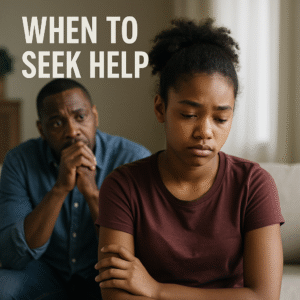

You wake up early, make sure there’s food in the house, pay school fees, cover transport, data, clothes, and somehow you’re still the bad guy.
When you ask your teenager to help around the house, they sigh.
When you say no to something extra, they act offended.
You start wondering, How did basic expectations become such a big issue?
You love your child and want the best for them, but you also feel drained, unappreciated, and unsure whether you’re being too hard or not firm enough.
This tension is becoming normal in many homes. It doesn’t mean your teen is bad, and it doesn’t mean you’ve failed.
Entitlement is learned, often unintentionally.
To change it, you need to see where it starts. The first reason may be closer to home than you think. Let’s jump right into it.
1 – Comfort Has Replaced Character

You probably didn’t plan to raise an entitled teen.
You simply wanted life to be easier for them than it was for you. So you step in quickly when things get uncomfortable.
You smooth over frustration, reduce effort, and remove obstacles wherever you can.
Over time, your teen learns that discomfort is something adults are supposed to eliminate.
Hard work, waiting, and inconvenience start to feel like unfair treatment.
This is how comfort culture shapes entitled teens. When effort is optional, and ease is guaranteed, character has no space to form.
Resilience, patience, and grit only develop when a young person has to carry weight.
Without that weight, teens expect life to adjust to them instead of learning how to adjust themselves to life.
The following table differentiates comfort vs character Formation.
| Comfort-Based Parenting | Character-Building Parenting |
| Immediate rescue | Allow struggle |
| Remove inconvenience | Require effort |
| Fill boredom | Expect initiative |
| Prioritize ease | Prioritize growth |
How to Fix It
- Give your teen real responsibilities that affect others, not symbolic chores
- Let boredom exist instead of rushing to entertain or distract
- Allow natural consequences to teach lessons you don’t need to lecture about
- Connect rewards directly to effort and consistency
- Communicate clearly that ease is not the goal, growth is
Learn more: Are Kenyan Parents Treating Teen Emotions Like Disorders?
2 – Parents Have Confused Love With Indulgence
You love your teenager, and that love often shows up as giving more chances, more resources, more freedom.
But love without limits quietly turns into indulgence.
When saying no feels harsh or unkind, you may start avoiding it altogether.
Over time, your teen learns that persistence, emotional reactions, or pressure will eventually get them what they want.
Indulgence teaches a dangerous lesson: my desires outrank authority.
Teens raised this way struggle with self-discipline because it was never required of them.
They don’t learn how to sit with disappointment or respect boundaries they didn’t choose.
Instead, they equate love with access, approval, and constant accommodation.
As clinical psychologist Dr. Becky Kennedy often emphasizes, our role isn’t to prevent our children’s distress, but to provide the structure that helps them navigate it. She notes:
“Boundaries are the ultimate act of love because they provide the safety of knowing someone is in charge. When we hold a limit, we are telling our child, ‘I love you enough to be the person you’re mad at right now.’”
Firm parenting is not cold parenting. Clear boundaries actually make teens feel safer, even when they protest.
Authority gives structure to their world and helps them develop internal discipline later in life. When love is paired with limits, entitlement loses its grip.
How to Fix It
- Say no calmly without overexplaining or apologizing
- Stop negotiating rules that are already reasonable
- Separate empathy (“I understand you’re upset”) from permission (“The answer is still no”)
- Hold boundaries even when your teen is unhappy
- Remember that discomfort does not mean harm
3 – Teens Are Rarely Held Accountable

Entitlement grows fastest in environments where accountability is inconsistent.
If rules change based on mood, excuses are easily accepted, or consequences disappear over time, teens learn that responsibility is optional.
They begin to expect second chances without correction and outcomes without effort.
For example, your teen forgets an assignment. You email the teacher. They miss a chore. You do it yourself. They break a rule. You warn them, but don’t follow through.
None of these moments feel serious on their own, but together they teach your teen that someone else will absorb the cost of their choices.
Accountability is not about punishment, but teaching them the realities of life.
Teens need to experience the connection between behavior and outcome while the stakes are still manageable.
When accountability is missing at home, the real world becomes a brutal teacher later.
How to Fix It
- Follow through on consequences every single time
- Require your teen to fix or replace what they damage
- Stop accepting repeated excuses without change
- Let school, work, and social consequences stand
- Model accountability by owning your own mistakes openly
Explore more: When Teens Go Quiet: How to Break the Wall of Silence at Home
4 – Teens Have Been Given Privileges Without Responsibility
You probably gave your teen certain privileges because it felt reasonable at the time.
A phone made communication easier. More freedom felt like trust. Extra money felt like support.
But when these things come before responsibility, your teen doesn’t experience them as trust; they experience them as normal.
Over time, access turns into expectation, and expectation turns into entitlement.
When your teen has adult-level privileges without adult-level self-control, you end up managing problems you didn’t create.
You’re monitoring screens, arguing about curfews, and pulling back freedoms that were never tied to behavior in the first place.
That back-and-forth creates resentment on both sides. Your teen feels controlled. You feel disrespected.
Jordan Peterson often points out that freedom without responsibility leads to chaos, not maturity.
Teens don’t grow into responsibility by being trusted blindly; they grow into it by carrying manageable burdens and proving they can handle them.
When privilege is earned slowly, it builds confidence and self-respect. When it’s handed out freely, it weakens both.
How to Fix It
- Decide what behavior earns each privilege and state it clearly
- Reduce privileges immediately when responsibility drops
- Increase freedom gradually, not emotionally
- Stop arguing about access that hasn’t been earned
- Teach your teen that privilege is tied to trust
5 – Purpose Has Been Replaced With Pleasure

When you look at your teen, you might notice how easily boredom turns into irritation.
Too much screen time, constant entertainment, and low motivation aren’t just habits; they’re signs of missing purpose.
When nothing meaningful is required of your teen, they naturally focus on comfort.
What feels good, what’s fair, what they want right now becomes the center of their world.
You may think you’re being kind by letting them relax, but over time, comfort without contribution drains them.
Teens want to feel useful, even if they don’t say it out loud. When they aren’t needed, they become demanding.
When nothing depends on them, everything feels owed to them.
Purpose doesn’t come from lectures or motivational talks. It comes from responsibility that matters.
When your teen’s effort affects other people, something shifts.
They stand a little straighter. Complaints reduce. Entitlement loses its grip because life stops revolving around them.
How to Fix It
- Give your teen responsibilities that genuinely help the family
- Let others depend on their follow-through
- Reduce passive entertainment time deliberately
- Speak more about contribution than feelings
- Help your teen see that meaning comes from being needed
Let ParenTeen Kenya Help
If you’re seeing entitlement in your teenager, it doesn’t mean you’ve failed—it means something needs to be corrected while there’s still time. Entitlement isn’t fixed with lectures or anger, but with structure, responsibility, and consistency.
When you reintroduce boundaries, accountability, and purpose, you give your teen something far more valuable than comfort: the tools to face real life. Parenting through this stage is demanding, and you don’t have to do it alone.
ParenTeen Kenya offers parent training on raising responsible, resilient teens, as well as one-on-one therapy for teenagers who are struggling.
Getting support now can change the direction of your family and your teen’s future for the better. Talk to us Today.

Jane Kariuki is a devout Christian, Clinician, Psychologist, and founder of ParenTeen Kenya. She authored an exceptional training manual used in her teens’ workshop and an instructional guidebook for her parenting classes. If she is not training, blogging, or counseling, Jane loves to spend time with her sweet husband and three children.