
I have two sons, and like many parents, I feel the quiet tension of raising boys in a world that seems unsure what to do with them.
Everywhere, strength is shamed, discipline is questioned, and masculinity is treated as something to apologize for rather than to form wisely.
Yet boys do not become good men by being shielded from challenge or praised without effort.
They become men through responsibility, restraint, courage, and meaning.
This article is not about clinging to the past or aggression; it is about helping sons develop inner strength in a culture that often rewards weakness.
If we want our sons to grow into capable, grounded, and morally steady men, we must be intentional, especially when the culture is not.
Why Strength Is Being Redefined, and Why Boys Are Paying the Price

You’ve likely noticed the change: modern culture often treats traditional masculine traits, like competitiveness, composure, and assertiveness, as problems to be fixed rather than assets to be acquired.
When we tell boys that their natural drive to win or lead is toxic, we aren’t making them more compassionate; we are making them ashamed of their own nature.
This confusion leaves your son in a state of failure to try, where he feels that the only way to be a “good man” is to be a weak one.
When ambition is labeled as aggression, boys internalize a sense of directionless anxiety.
Research published in the Journal of Health and Social Behavior suggests that when boys are discouraged from developing traditional masculine strengths like self-reliance, they actually show higher rates of depression and social withdrawal.
By redefining weakness as a virtue, we strip them of the very tools they need to live in a tough world. The following points illustrate how this cultural shift manifests in a young man’s daily life:
- The Shame Cycle: Boys feel guilty for being competitive, so they stop trying altogether.
- The Loss of Drive: Without a mountain to climb, energy turns into screen addiction or apathy.
- Fragility as an Identity: When we celebrate sensitivity over resilience, boys become easily offended and hard to lead.
- The Authority Gap: They lose respect for boundaries because they’ve been told all authority is oppressive.
To counter this, start by validating your son’s desire to win and be strong. Stop apologizing for his high energy or his competitive spirit.
Instead, give him productive channels for that fire, like demanding sports or complex hobbies, and tell him explicitly that his strength is a gift meant to be developed, not a flaw to be suppressed.
Related: The Entitled Generation: 5 Reasons Your Teen Expects Everything and How to Fix It
Teaching Responsibility Before Rights: The Foundation of Manhood
In a world obsessed with what I’m owed, you must teach your son what I owe to others.
Your son is born a boy, but he has to build himself into a man.
Jordan Peterson famously notes, “The secret to a meaningful life is to find the heaviest burden you can carry and move it.”
If you protect your son from responsibility, you are essentially stealing his chance to feel like he matters.
Confidence doesn’t come from your Good job! stickers; it comes from him looking at a difficult task and realizing, I did that.”
The table below compares the path of least resistance with the path of masculine growth:
| Area of Life | The “Weak” Approach | The “Strong” Approach | Result |
| Household | He does chores only for a reward. | He manages his own laundry and repairs. | Competence |
| Finances | You pay for his every want/subscription. | He earns the money for his “wants.” | Ownership |
| Mistakes | You call the coach/teacher to complain. | He speaks to the authority figure himself. | Accountability |
| Daily Routine | You wake him up for school/work. | He manages his own alarm and schedule. | Self-Rule |
Your move forward is to assess your home for learned helplessness.
Identify three things you are currently doing for your son that he is perfectly capable of doing for himself, and hand those keys over immediately.
Expect resistance, but stay firm; you are transitioning him from a consumer of the family’s resources to a contributor to the family’s strength.
Masculinity Is Not Toxic: Integrating Strength with Character
The goal isn’t to raise a bully, nor is it to raise a victim.
You want to raise a protector.
There is a false narrative today that says strength is inherently dangerous. In reality, a man who has no capacity for aggression isn’t good; he’s just harmless.
Real character is the ability to be powerful but keep that power under discipline.
Think of it like a controlled fire: in a fireplace, it keeps the house warm; out of control, it burns the house down.
Use the following pillars to help him build that fireplace for his masculine energy:
- Controlled Aggression: Channeling his physical energy into martial arts, sports, or hard labor.
- Courage over Safety: Teaching him that feeling afraid is fine, but acting anyway is mandatory.
- Service-Based Leadership: Showing him that the strongest person in the room is the one who helps the most.
- Moral Restraint: The discipline to walk away from a fight he knows he would win.
Practical application starts with mentorship.
Help him find a hero or a mentor, whether a coach, an uncle, or a historical figure, who embodies strength under control.
Discuss how that man uses his power to build things rather than break them, and challenge your son to find one area this week where he can use his physical or mental strength to serve someone else.
Learn more: Are Kenyan Parents Treating Teen Emotions Like Disorders?
The Cost of Overprotection: Why Shielding Boys Weakens Them

Imagine a young man named Leo. Every time Leo forgot his homework, his mom took it to school. When he got a C, she emailed the teacher about his stress levels.
When he faced a bully, she had him moved to a different class. Leo is now 22, living in the basement, terrified of a job interview because he’s never tasted the sting of a real consequence. By “saving” him, his parents accidentally disabled him.
Psychologist Jonathan Haidt, in his research on The Coddling of the American Mind, highlights how safetyism (the cult of overprotection) actually prevents the brain from developing the anti-fragility it needs to handle life.
To let go, you have to accept that your son will get hurt, he will fail, and he will be treated unfairly.
Your job isn’t to pave the road for him; it’s to prepare him for the road.
The action point here is simple but difficult: the next time your son faces a minor crisis, a failed test, a social slight, or a broken item, resist the urge to fix it.
Instead of asking, “How can I make this go away?” ask him, “What is your plan to handle this?”
Be his consultant, not his savior.
Letting go is the hardest part of parenting; my therapy services offer the support you need to stop rescuing and start empowering. We will work together to build your son’s resilience by changing how you respond to his struggles.
Raising Sons with Moral Spine in a Confused World
In a culture of your truth and my truth, your son needs The Truth.
Without a moral anchor, he will be blown about by every trendy ideology that comes across his social media feed.
Building a moral spine means teaching him that integrity is more important than popularity.
If he can’t stand up for what is right when it’s inconvenient, he will never stand up for anything at all.
He needs to see you modeling a life where your yes means yes and your no means no. Use these steps to begin cementing his moral foundation:
- Define the Code: Sit down and write 5 non-negotiable family values (e.g., We tell the truth, We don’t complain).
- Audit the Input: Look at the influencers he consumes. If it’s all about victimhood, introduce better voices.
- Practice Public Courage: Encourage him to speak his mind politely in groups, even if his opinion is unpopular.
- Demand Honesty: Make the penalty for lying much harsher than the penalty for the mistake itself.
- Model the Burden: Let him see you working hard and standing by your principles despite the cost.
The way forward is to start having courageous conversations at the dinner table.
Pick a controversial topic and ask him what he truly thinks, not what he thinks his teachers want to hear.
Praise him when he shows a spine by disagreeing with the crowd, and remind him that a man who stands for nothing will fall for anything.
Let PTK Help You Raise a Resilient Man
Raising a son today is a battle against a tide that wants him soft and silent. But by choosing responsibility over comfort, you’re giving him a life of real meaning.
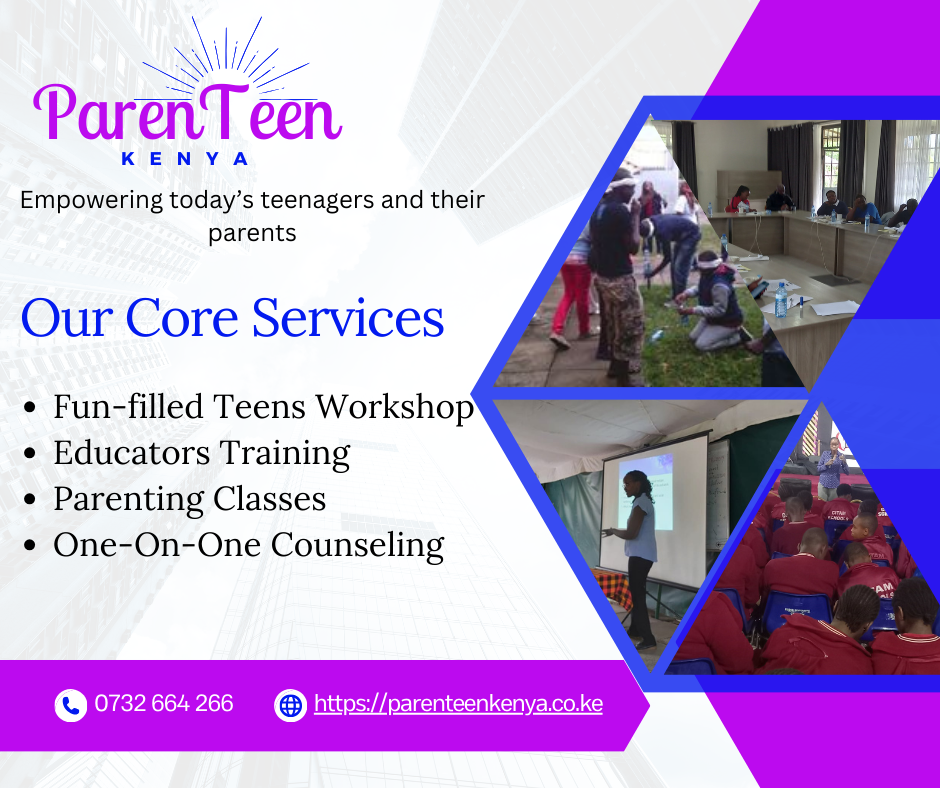
If you’re struggling to bridge the gap with your teen, ParenTeen Kenya is here to help.
Explore our training and therapy services today. Let’s work together to build the strong, resilient man your son was meant to be.

Jane Kariuki is a devout Christian, Clinician, Clinical Psychologist, and founder of ParenTeen Kenya. She authored an exceptional training manual used in her teens’ workshop and an instructional guidebook for her parenting classes. If she is not training, blogging, or counseling, Jane loves to spend time with her sweet husband and three children.