If you are raising a teenager right now, you already know it is not easy. The challenges you are facing are louder, faster, and more complex than anything your own parents faced.
Your teenager has a smartphone in their pocket, a social media presence, opinions about everything, and the ability to find information in seconds.
And yet, underneath it all, your teenager still needs the one thing every generation of teenagers has needed: structure.
Not rules for the sake of control.
Structure because boundaries are how young people learn to function in the real world.
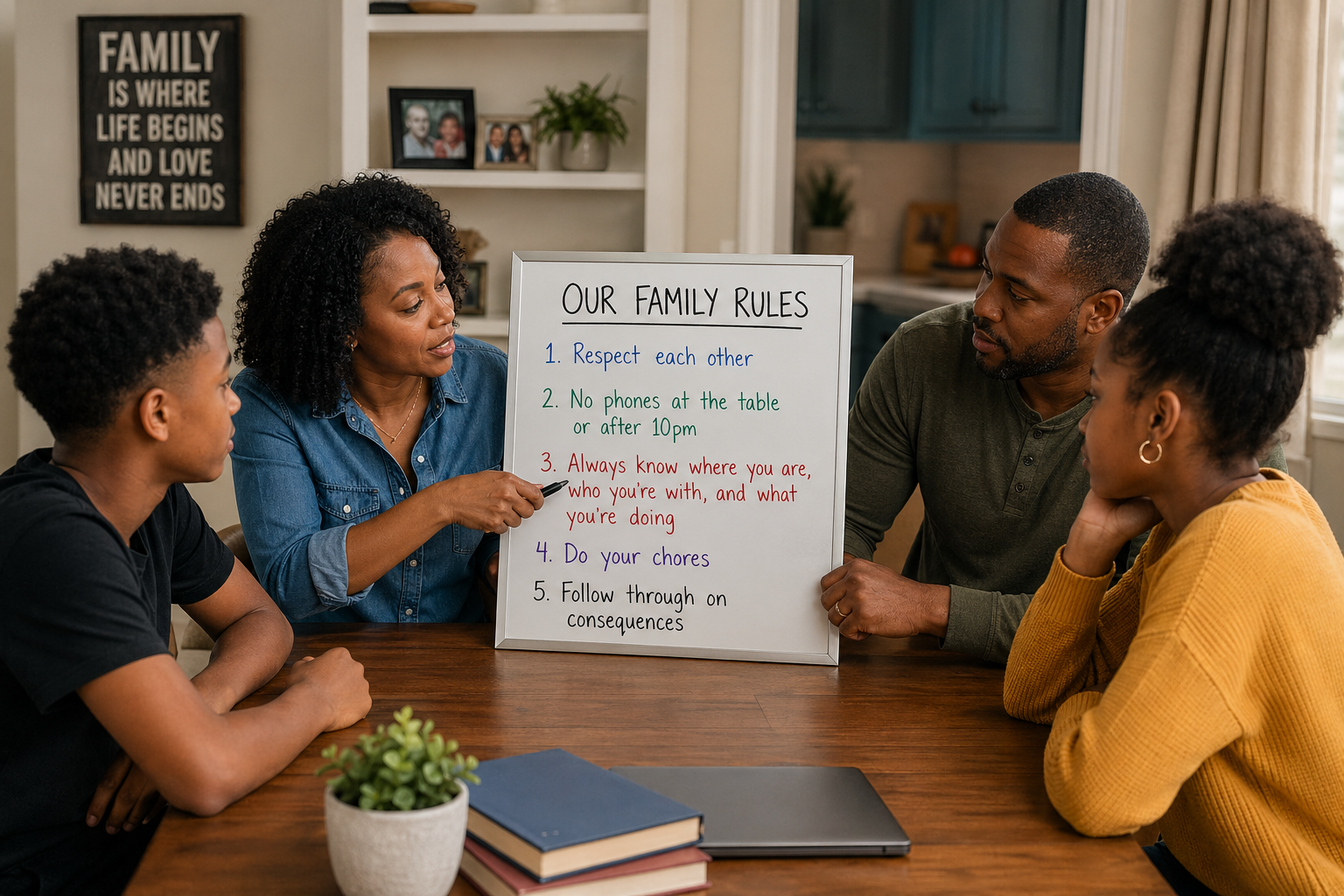
The families raising confident, responsible teenagers tend to have one thing in common: they have clear, consistent household rules that are not up for negotiation depending on the mood of the week. Let’s look at five of these rules.
Rule 1: No Unrestricted Phone or Social Media Use

Think about what your teenager can access online within seconds.
At 13, 14, or 16, they can encounter content that even adults struggle to process.
Social media platforms are designed to keep them engaged with scrolling, comparing, reacting and commenting.
Leaving this completely unregulated is not harmless; it has real implications for sleep, attention, and mental health.
A 2023 report by the American Psychological Association found links between heavy social media use and increased anxiety, depression, and poor body image in teenagers. This does not mean banning technology, but it does mean guiding how it is used.
Clear structure around devices teaches teenagers that access comes with responsibility.
Without it, most will drift into overuse because their brains are still developing impulse control.
Here is what this rule should look like in practice:
- Phones are off or out of bedrooms at a set time each night
- Social media is used in shared spaces, not in isolation behind closed doors
- Screen time limits are agreed on and enforced consistently
- Parents have the right to review online activity when necessary
- Consequences for misuse are clear and applied every time
Taking this action will help you raise a teenager who knows how to use technology without being controlled by it.
If this area is already a source of constant conflict in your home, structured parent training can help you implement these boundaries in a way that actually works day to day.
Learn More: 5 Reasons Parents Are Losing Their Teenagers to Progressive Ideology (And How to Stop It)
Rule 2: You Must Speak Respectfully, Even When You’re Angry or Disagree
Your teenager will disagree with you. That is part of development.
The issue is not disagreement; it is how that disagreement is expressed.
When frustration turns into insults, shouting, or withdrawal, those patterns do not stay in your home. They follow your teenager into friendships, relationships, and eventually the workplace.
As psychologist Lisa Damour explains in her book, the emotional lives of teenagers, teens need adults who model how to hold strong emotions without becoming disrespectful.
Respectful communication is not automatic; it is taught, practiced, and enforced.
The following table shows what that looks like in real situations:
| Situation | Disrespectful Response | Respectful Response |
| Disagreement | “You never listen, this is stupid!” | “I don’t agree, can we talk about it?” |
| Being told no | “You’re the worst parent” | “I’m disappointed, can you explain why?” |
| Frustration | Slamming doors, silent treatment | “I need a moment, I’ll come back to this” |
| Correction | Walking away, muttering insults | “That upset me, can we talk privately?” |
The rule is simple: your teenager can feel anything, but they cannot express it with disrespect.
When you hold this line consistently and model it yourself, you create a home where communication stays open even during conflict.
Rule 3: If You Break a Rule, There Will Always Be a Consistent Consequence
Teenagers test boundaries to figure out which ones are real.
If your consequences are inconsistent, rules quickly lose meaning. It leads to labelling your child as difficult, yet it is the home that doesn’t have a predictable, enforceable system.
Consider this scenario that will feel familiar to many parents:
Amara is 15 years old. The household rule is clear: no phone after 10pm on school nights. One Tuesday, her mother notices the light under Amara’s door at midnight and hears the soft tap of a keyboard. She opens the door, finds Amara on her phone, and says, “I’ll deal with this tomorrow.” Tomorrow comes. The week gets busy. Nothing happens. The following Tuesday, Amara is on her phone at 11pm, and this time she does not even try to hide it.
This is not a story about a bad parent or a manipulative teenager.
It is what happens when a consequence is promised and not delivered. Amara did not decide to rebel; she learned that the rule was not real.
In contrast, when the response is predictable, every time the rule is broken, a specific consequence follows, the teenager learns quickly.
Teenagers adjust faster when they know exactly what will happen.
The key is to agree on consequences in advance and apply them calmly. No long lectures, no emotional reactions. The consequence itself does the teaching.
When rule-breaking becomes frequent or escalates, it often signals deeper issues such as peer influence, emotional struggles, or poor impulse control.
In such cases, our teen workshops or therapy sessions can help address the root of the behaviour rather than just the surface.
Rule 4: We Must Know Where You Are, Who You’re With, and What You’re Doing
Teenagers are in environments that include peer pressure, substance exposure, and unpredictable social situations.
Your teen’s independence is important, but it must be built on accountability.
When you do not know where your teenager is or who they are with, you lose the ability to step in when needed.
Clear expectations reduce risk and increase trust over time. The following are guidelines for what this rule should include:
- Your teenager shares where they are going before leaving the house.
- You know who they will be with, not just “friends.”
- They check in when they arrive and update you if plans change.
- Their phone remains reachable at all times.
- You have general awareness of their online interactions and communities.
When this is framed as protection rather than suspicion, most teenagers respond better than expected.
It communicates: “We trust you, and we are responsible for your safety.”
If your teenager resists this boundary strongly, it may point to trust or communication gaps that need deeper attention.
Reach out to ParenTeen Kenya for further guidance.
Learn More: The Entitled Generation: 5 Reasons Your Teen Expects Everything and How to Fix It
Rule 5: You Are Responsible for Chores and Personal Duties
Many teenagers grow up doing little to contribute at home, and it shows later.
Responsibility is not something that suddenly appears in adulthood, it is practiced daily in the home.
When chores are optional or tied to rewards, your teenager learns that effort is negotiable.
As Julie Lythcott-Haims in her book, How to raise and adult, argues that over-functioning parents often raise underprepared adults.
Your teen’s contribution in the home is about belonging and taking responsibility, and not helping you.
The following are the steps to take to implement this effectively:
- Sit down and outline what it takes to run the home (cleaning, cooking, laundry, errands).
- Assign age-appropriate responsibilities and increase them as your teen grows.
- Create a visible system (chart or shared list) to reduce constant reminders.
- Keep chores separate from rewards; this is not optional
- Apply consistent consequences when responsibilities are ignored
The goal is not perfection.
It is raising a teenager who understands that life requires effort and contribution. That mindset carries into every future environment, including university, work, relationships, and family life.
Turning These Rules Into Daily Practice (With the Right Support)
If you find yourself struggling to stay consistent, facing constant pushback, or unsure how to implement these rules without conflict, you do not have to figure it out alone.
Our parent training sessions are designed to give you practical tools, clear systems, and real-life strategies that work with today’s teenagers, not against them.
Whether you need support in setting boundaries, improving communication, or handling resistance, we walk with you step by step.
Reach out today and start building a home environment that works for you and your teenager.

Jane Kariuki is a devout Christian, Clinician, Clinical Psychologist, and founder of ParenTeen Kenya. She authored an exceptional training manual used in her teens’ workshop and an instructional guidebook for her parenting classes. If she is not training, blogging, or counseling, Jane loves to spend time with her sweet husband and three children.