Arguments with teenagers can turn an ordinary instruction into a confrontation.
A request to finish homework, put away a phone, or return home on time may be met with complaints, defiance, or disrespect.
Parents must know how to respond without losing their temper or allowing inappropriate behavior to continue.
The goal is not simply to end an argument; it is to raise a young adult who understands authority, accepts responsibility, and can disagree respectfully.
Knowing how to handle arguments with teenagers requires clear household standards, consistent discipline, appropriate consequences, and a willingness to listen without abandoning parental responsibility.
You can show your teenager grace while holding them accountable. Here are four practical ways to lead with conviction, wisdom, and self-control.
1- Establish Clear Rules and Expectations Before Conflict Begins
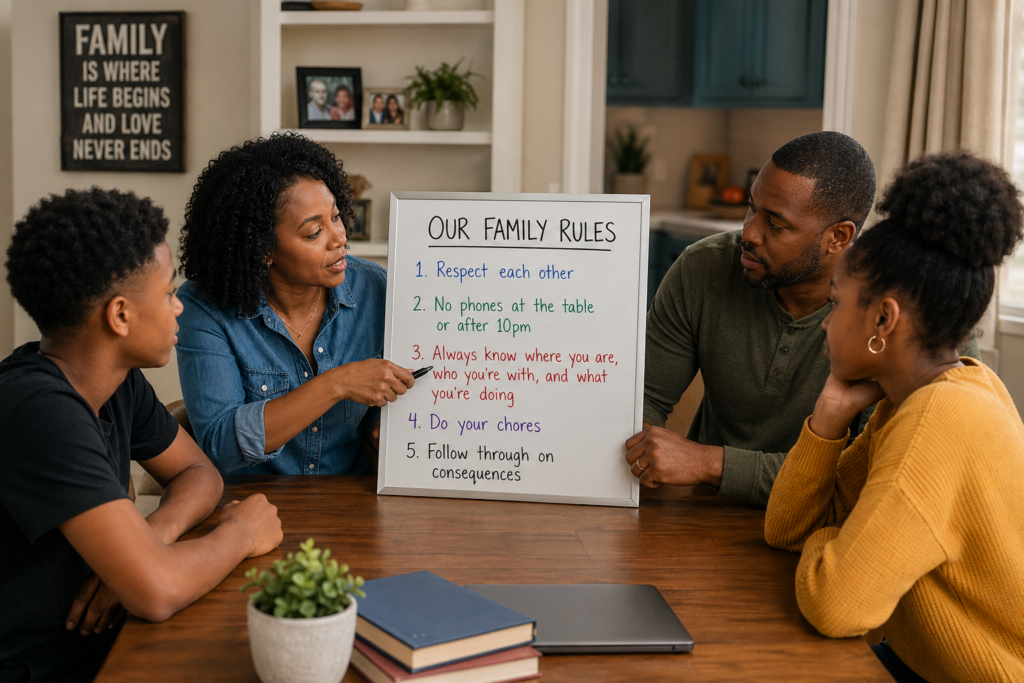
It is difficult to enforce rules that have never been clearly established.
Parents should not have to negotiate every instruction or invent consequences in the heat of an argument.
A well-ordered home has clear standards that teenagers understand and are expected to follow.
Biblical discipline involves both instruction and correction.
Ephesians 6:1–4 addresses children’s obedience and parents’ responsibility to raise them with discipline and instruction.
Parental authority should therefore be exercised purposefully, not according to whichever emotion dominates a difficult moment.
Establish a few clear family standards such as:
- Define non-negotiable expectations. These might include honesty, respectful speech, school responsibilities, reasonable curfews, and safety rules.
- Explain consequences in advance. Teenagers should understand what follows when they repeatedly break an agreement.
- Connect freedom to responsibility. Greater independence should come with demonstrated honesty, reliability, and sound judgment.
For example, if your teenager repeatedly misses curfew, another angry lecture followed by unrestricted outings will not address the problem.
You might temporarily restrict late outings until they demonstrate that they can keep the agreed time.
Parents who struggle with inconsistent discipline may benefit from parenting training that helps them establish boundaries and enforce them confidently.
The goal is not to control every aspect of a teenager’s life but to create a predictable home where expectations matter and everyone is accountable.
Related: 4 Reasons Your Teen Chooses the Wrong Crowd
2- Stay Calm Without Backing Down
When your teenager raises their voice, challenges your decision, or makes an insulting remark, you may feel tempted to shout back.
But losing your temper can turn a correction into a battle between two angry people.
Equally, remaining silent while repeated disrespect goes unchecked can suggest that the behavior is acceptable.
Staying calm does not mean being permissive.
It means maintaining control of yourself while addressing your teenager’s behavior firmly.
Proverbs 15:1 teaches that a gentle answer can turn away wrath.
A measured response can help de-escalate conflict without requiring you to withdraw a reasonable boundary.
In the moment, focus on three things:
- Correct disrespect immediately: Say, “You can disagree with my decision, but you may not insult me. We can continue when you speak respectfully.”
- Stop repetitive arguments: Explain your decision, answer reasonable questions, and make it clear when the discussion is over.
- Follow through: If the behavior warrants an established consequence, enforce it calmly rather than making threats you will not carry out.
If your teenager becomes too upset to have a constructive conversation, pause and specify when you will resume it.
The break should not become an excuse to avoid the original issue.
Remember that you do not need the last word to exercise authority.
Your responsibility is to make expectations clear and respond consistently.
Where arguments repeatedly escalate into intense anger or aggression, counseling from an experienced teen therapist may help teenagers develop emotional regulation skills, while parents can learn more effective ways to respond.
3- Listen to Your Teenager Without Surrendering Your Decision

Teenagers need opportunities to express concerns, explain their reasoning, and learn how to disagree respectfully.
However, being heard does not mean having the final say.
Parents remain responsible for decisions concerning safety, household standards, and appropriate boundaries.
Consider this scenario: Your 15-year-old asks to attend a party ending at 11 p.m. You decline because you are concerned about supervision and transport. Your teenager responds, “You never let me do anything! All my friends are going.”
Rather than arguing about what other parents allow, you could say: “I understand that you want to go, and I have heard your concerns. I am responsible for your safety, and I am not comfortable with these arrangements. If there is a safer alternative, I will consider it, but shouting will not change my decision.”
This is conflict resolution between parents and teens in practice whereby you are hearing a concern without changing the boundary.
You can reconsider a decision when circumstances justify it.
But if you have heard your teenager’s concerns and made a reasonable decision, you do not need to keep defending it indefinitely.
For parents who find these conversations difficult, ParenTeen Kenya’s parent training and coaching can help develop practical communication skills while maintaining parental authority.
4- Enforce Consequences and Require Accountability
Some arguments end because a parent gives in.
Others end because a teenager withdraws or refuses to speak.
Neither outcome necessarily resolves the underlying problem.
When teenagers repeatedly break rules, lie, or behave disrespectfully, parents must address the behavior rather than simply waiting for tempers to settle.
Discipline should teach responsibility, not merely express anger. The table below shows appropriate consequences you can take for certain behaviors:
| Behavior | Appropriate consequence |
| Repeatedly breaking curfew | Temporarily restrict late outings and require a period of reliable timekeeping. |
| Misusing phone privileges | Restrict access for a defined period and establish expectations for responsible use. |
| Damaging property | Require appropriate restitution or participation in repairs. |
| Breaking trust through dishonesty | Require greater transparency while trust is rebuilt through consistent honesty. |
Hebrews 12:11 acknowledges that discipline can be painful in the moment but can produce righteousness and peace in those trained by it.
Consequences should be proportionate, explained clearly, and enforced consistently.
Avoid humiliation, retaliation, or threats made in anger. Equally, do not remove a justified consequence simply because your teenager becomes upset.
Once everyone is calm, revisit the issue. Require your teenager to acknowledge their responsibility, make amends where necessary, and understand what must change.
If you shouted unnecessarily, apologize for your own behavior without withdrawing a justified consequence for theirs.
The goal is to help teenagers understand that actions have consequences, trust must be rebuilt, and reconciliation includes taking responsibility.
Helping Your Family Navigate Teen Conflict
Raising teenagers means preparing them to manage emotions, respect appropriate authority, accept correction, and take responsibility for their choices. These lessons are learned through everyday family interactions, particularly when expectations are tested.
Parenteen Kenya (PTK) offers parent training and coaching to help caregivers manage challenging behavior and establish consistent boundaries, alongside teen and young adult therapy for emotional and behavioral difficulties affecting relationships and daily life.
If arguments have become a regular feature of family life, practical support can help you respond more confidently and consistently. Book a session with us today.

Jane Kariuki is a devout Christian, Clinician, Clinical Psychologist, and founder of ParenTeen Kenya. She authored an exceptional training manual used in her teens’ workshop and an instructional guidebook for her parenting classes. If she is not training, blogging, or counseling, Jane loves to spend time with her sweet husband and three children.